

Note
Go to the end to download the full example code.
NCL_lcnative_1.py#
- This script illustrates the following concepts:
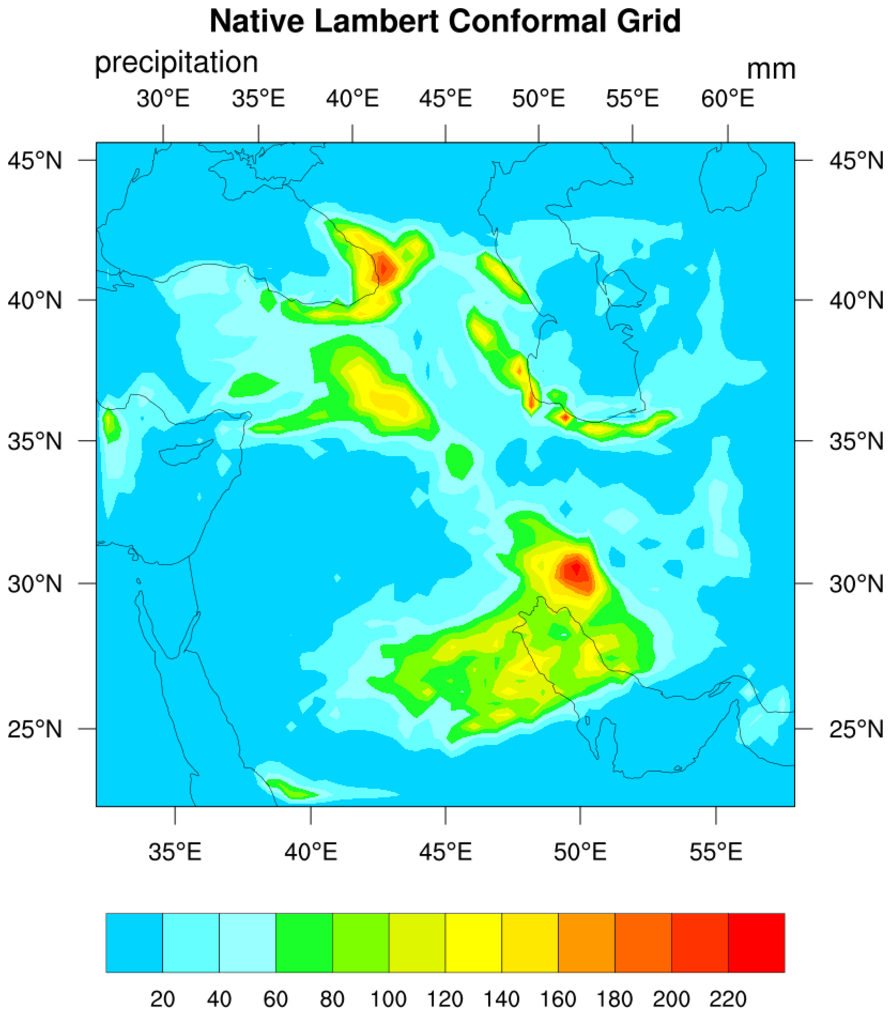
Drawing contours over a map using a native lat,lon grid
Drawing filled contours over a Lambert Conformal map
Zooming in on a particular area on a Lambert Conformal map
Subsetting a color map
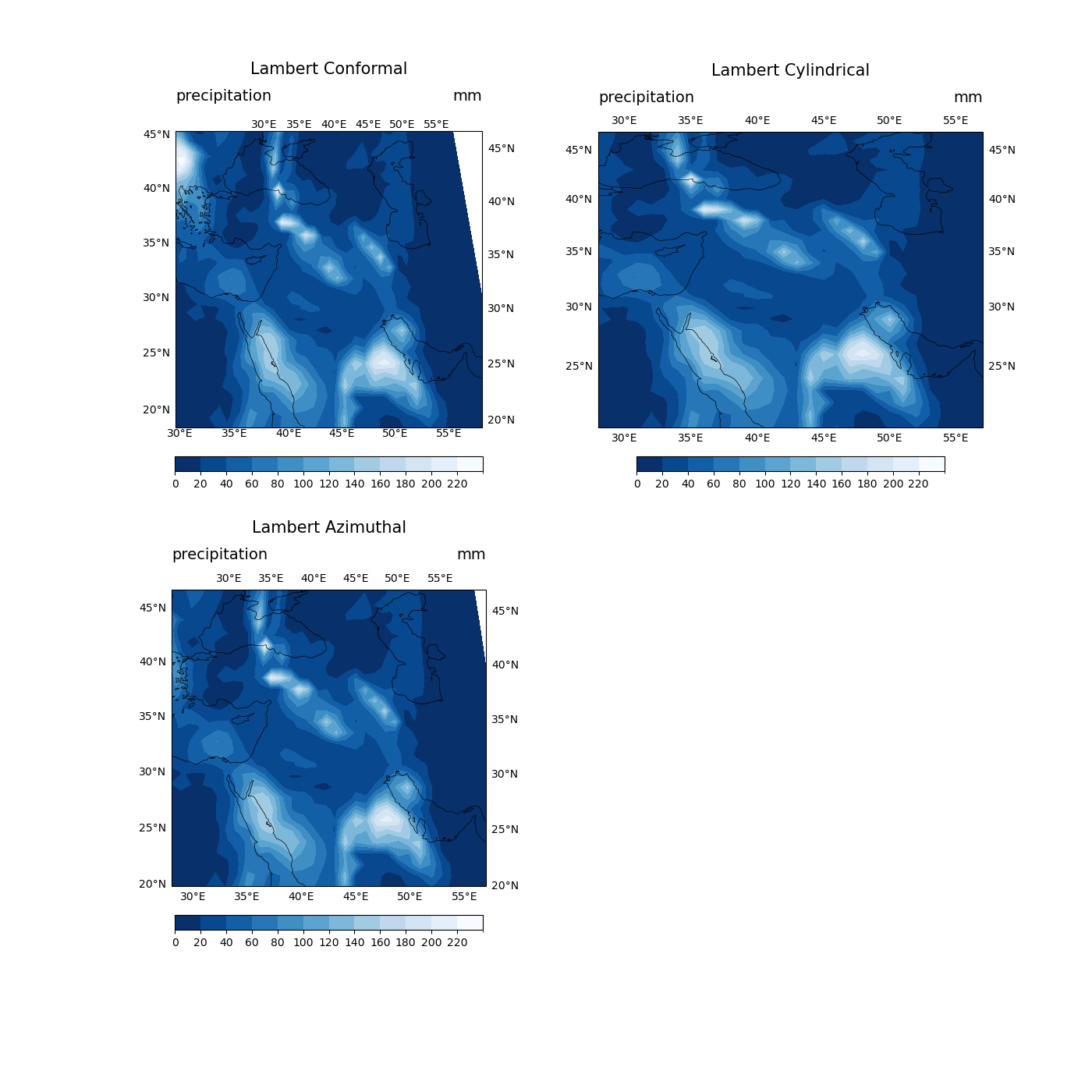
Using all three Cartopy Lambert projections to find the best fit for visualization
Implementing best practices for choosing contour color scheme. The original NCL version uses a rainbow color map which can create problems for individuals impacted by color blindness and is not black and white printer friendly. To overcome this, we used the “Blues_r” color scheme from Matplotlib. More information on best practices can be found here.
- See following URLs to see the reproduced NCL plot & script:
Original NCL script: https://www.ncl.ucar.edu/Applications/Scripts/lcnative_1.ncl
Original NCL plot: https://www.ncl.ucar.edu/Applications/Images/lcnative_1_lg.png
Import packages:
import numpy as np
import xarray as xr
import cartopy.crs as ccrs
import matplotlib.pyplot as plt
import matplotlib.ticker as mticker

import geocat.datafiles as gdf
Read in data:
# Open a netCDF data file using xarray default engine and load the data into xarrays
ds = xr.open_dataset(gdf.get("netcdf_files/pre.8912.mon.nc"), decode_times=False)

# Extract a slice of the data
t = ds.pre.isel(time=0)
Plot:
plt.figure(figsize=(14, 14))


def Plot(row, col, pos, proj, title):
    '''
    Args:

        row (:class: 'int'):
            number of rows necessary for subplotting of visualizations
        col (:class: 'int'):
            number of columns necessary for subplotting
        pos (:class: 'int'):
            position of visualization in m x n subplot
        proj (:class: 'cartopy.crs'):
            which projection to visualize
        title (:class: 'str'):
            center title of respective visualization
    '''
    # Generate axes using Cartopy and draw coastlines
    ax = plt.subplot(row, col, pos, projection=proj)
    ax.set_extent((28, 57, 20, 47), crs=ccrs.PlateCarree())
    ax.coastlines(linewidth=0.5)

    # Use ax "gridlines" function to draw lat/lon markers on projections
    gl = ax.gridlines(draw_labels=True, dms=False, x_inline=False, y_inline=False)
    gl.top_labels = True
    gl.right_labels = True
    gl.xlines = False
    gl.ylines = False
    gl.xlocator = mticker.FixedLocator([30, 35, 40, 45, 50, 55])
    gl.ylocator = mticker.FixedLocator([20, 25, 30, 35, 40, 45])
    gl.xlabel_style = {'rotation': 0}
    gl.ylabel_style = {'rotation': 0}
    """When using certain types of projections in Cartopy, you may find that
    there is not a direct 1-to-1 projection similarity.

    When looking at the three Lambert projections offered, you will
    notice the closest match to the NCL projection is actually the
    Lambert Cylindrical projection. This is due to NCL having certain
    "smoothing" and "flattening" options for the Lambert Conformal
    projection not seen in the Cartopy version. By using Lambert
    Cylindrical over Lambert Conformal in Python, you will be able to
    create the "rectangular" style of coordinates not classically
    represented by a Lambert Conformal map. Additionally, Cartopy does
    not currently support adding tick marks to a projection like NCL,
    this is why these Python projections do not have this feature. The
    GeoCAT Team is actively adding to the list of convenience functions
    supported and hopes to add this functionality one day.
    """

    # Plot data and create colorbar
    prec = t.plot.contourf(
        ax=ax,
        cmap="Blues_r",
        transform=ccrs.PlateCarree(),
        levels=14,
        add_colorbar=False,
    )

    cbar_ticks = np.arange(0, 240, 20)
    cbar = plt.colorbar(
        prec, orientation='horizontal', pad=0.075, shrink=0.8, ticks=cbar_ticks
    )

    cbar.ax.tick_params(labelsize=10)
    plt.title(title, loc='center', y=1.17, size=15)
    plt.title(t.units, loc='right', y=1.08, size=14)
    plt.title("precipitation", loc='left', y=1.08, size=14)


Plot(
    2,
    2,
    1,
    ccrs.LambertConformal(
        central_longitude=45, standard_parallels=(36, 55), globe=ccrs.Globe()
    ),
    "Lambert Conformal",
)
Plot(2, 2, 2, ccrs.LambertCylindrical(central_longitude=45), "Lambert Cylindrical")
Plot(2, 2, 3, ccrs.LambertAzimuthalEqualArea(central_longitude=45), "Lambert Azimuthal")
Total running time of the script: (0 minutes 2.133 seconds)